Facelifts using short incisions are becoming increasingly popular in plastic surgery. This method is called a mini facelift. In some cases, especially when age-related changes in the upper part of the face are not very pronounced, it is possible to use an incision that is almost half as short as a conventional one.
A mini-facelift effectively eliminates age-related changes in the cheekbone area and the middle and lower parts of the face. This technique also allows the skin in the neck area to be tightened. During this operation, the muscular-aponeurotic system of the face (SMAS) is tightened, which guarantees long-lasting results.
The advantages of this operation are obvious. Not only is the incision short and inconspicuous, but the recovery period after the operation is also significantly shorter. Facial swelling subsides much earlier, and most patients return to their active lives by the end of the first week.
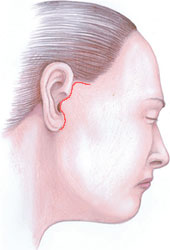
The figure shows a schematic line of the incision along which the suture will be made. In a mini facelift, the incision line runs in front of the ear, hidden behind it and does not extend to the neck. Over time, this suture becomes so inconspicuous that it is practically invisible to the naked eye. Plastic surgeon Dr. Slosser uses his own techniques to achieve the most inconspicuous stitches with the most natural results.
Facelifts using short incisions are becoming increasingly popular in plastic surgery. This method is called a mini facelift. In some cases, especially when age-related changes in the upper part of the face are not very pronounced, it is possible to use an incision that is almost half as short as a conventional one.
A mini-facelift effectively eliminates age-related changes in the cheekbone area and the middle and lower parts of the face. This technique also allows the skin in the neck area to be tightened. During this operation, the muscular-aponeurotic system of the face (SMAS) is tightened, which guarantees long-lasting results.
The advantages of this operation are obvious. Not only is the incision short and inconspicuous, but the recovery period after the operation is also significantly shorter. Facial swelling subsides much earlier, and most patients return to their active lives by the end of the first week.
The figure shows a schematic line of the incision along which the suture will be made. In a mini facelift, the incision line runs in front of the ear, hidden behind it and does not extend to the neck. Over time, this suture becomes so inconspicuous that it is practically invisible to the naked eye. Plastic surgeon Dr. Slosser uses his own techniques to achieve the most inconspicuous stitches with the most natural results.

Honored Doctor of Ukraine, Head of the Plastic Surgery Center
Prices
- Price, in uah
FAQ
In short, pain is manageable. Severe pain after surgery today is the exception rather than the norm. Modern anesthesia, pain management, and recovery protocols make the first days much easier than most patients expect. Most often, discomfort is felt as pressure or tightness. However, it is important to understand that complete absence of sensation is an unrealistic expectation. My position is clear: if a person is afraid of any discomfort, it is better to postpone surgery. The decision must be conscious and well considered.
No. Rehabilitation is part of the surgery, not a separate stage afterward. It is during the recovery period that the final result is formed, tissues stabilize, and the risk of complications decreases. Without proper rehabilitation, even a technically perfect operation may produce a weak outcome. There are procedures with an easier recovery (for example, “weekend lifts”), but surgery without rehabilitation does not exist.
The final result does not appear immediately. It develops gradually over time. Swelling, tissue firmness, and sensations change step by step. During the first weeks, the result is definitely not final, and this is completely normal. The timeline depends on the treated area, the extent of surgery, and individual characteristics of the body. Plastic surgery does not tolerate haste. A good result takes time.
It depends primarily on the type of work you do, not only on the surgery itself. After some procedures, it is possible to return to work within a few days (for example, after “weekend lifts”), while others require weeks of recovery. It is important to consider not only how you feel, but also the safety of the healing process. Returning to activity earlier than recommended increases the risk of complications. It is better to return later than to deal with the consequences of rushing.
Yes, scars always remain. This is part of the natural healing process. However, their appearance changes over time: they become lighter, softer, and less noticeable. Their location and proper care play a crucial role. Careful planning and patience are essential.
When the risks outweigh the benefits, or when the decision is driven by emotions. I refuse if I see that the body is not ready, expectations are unrealistic, or the person does not understand the recovery process. Refusal is also part of treatment. Safety is more important than any desire.
Yes, and it has a significant impact on the outcome. Honest answers, a list of questions, and a willingness to listen save time and help you make the right decision. A consultation is a diagnosis, not a sales pitch. A good consultation is half the success.

Calculate the cost of the operation: Mini facelift (mini facelift)
Leave your details and we will contact you for an accurate assessment of the operation
Materials on the topic
What is a Deep-Plane Facelift and How Does It Differ from a Classic Facelift?
The deep-plane facelift is a modern, technically demanding, but highly effective method of facial rejuvenation. It delivers natural results and significantly extends a youthful appearance. Unlike the classic facelift, it works with the fundamental structures of the face, restoring harmony without a “mask effect” and preserving natural expressions.
Facelift: the latest technologies for facial rejuvenation
Over the last 10 years, plastic surgery has made significant progress, and facelifts are no longer procedures that leave the face looking like a “mask.” Modern facelifts are a harmonious rejuvenation that takes into account the natural contours of the face and the individual characteristics of the patient, and has long-lasting results.