During pregnancy and lactation, the size of the areola can increase. The large size of the areola can cause some inconvenience in the lives of some women, primarily psychological. A simple surgical intervention will help to correct the situation.
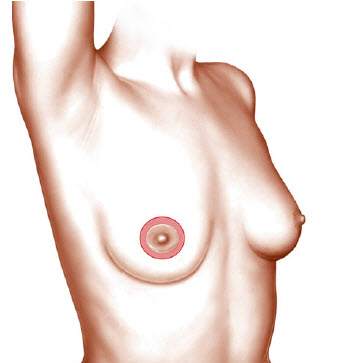
Areola reduction - periareolar breast lift The essence of the operation is to reduce part of the pigmented area of the areola without lifting the deep layers of the skin and glandular tissue. This operation has a high success rate. The size of the areola is reduced to 4-4.5 cm. It is also possible to correct the irregular shape of the areola. The function of the mammary gland is fully preserved. The procedure is performed under local anesthesia and with the use of intravenous anesthesia, which makes the procedure as comfortable and safe as possible. Most often, areola correction is performed as a stage of breast lift surgery or correction of congenital breast deformity (tubular breast deformity).
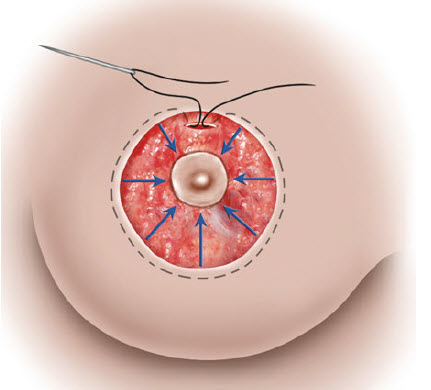
Benelli periareolar breast liftThe technique of areola reduction and breast lift surgery according to Benelli.
When using this method of areola reduction, the excess pigmented areola is removed and a special pouch suture is applied around the areola, which prevents further expansion of the areola diameter. This method of areola reduction is used as one of the stages of breast lift and correction of congenital breast asymmetry.

Honored Doctor of Ukraine, Head of the Plastic Surgery Center
FAQ
In short, pain is manageable. Severe pain after surgery today is the exception rather than the norm. Modern anesthesia, pain management, and recovery protocols make the first days much easier than most patients expect. Most often, discomfort is felt as pressure or tightness. However, it is important to understand that complete absence of sensation is an unrealistic expectation. My position is clear: if a person is afraid of any discomfort, it is better to postpone surgery. The decision must be conscious and well considered.
No. Rehabilitation is part of the surgery, not a separate stage afterward. It is during the recovery period that the final result is formed, tissues stabilize, and the risk of complications decreases. Without proper rehabilitation, even a technically perfect operation may produce a weak outcome. There are procedures with an easier recovery (for example, “weekend lifts”), but surgery without rehabilitation does not exist.
The final result does not appear immediately. It develops gradually over time. Swelling, tissue firmness, and sensations change step by step. During the first weeks, the result is definitely not final, and this is completely normal. The timeline depends on the treated area, the extent of surgery, and individual characteristics of the body. Plastic surgery does not tolerate haste. A good result takes time.
It depends primarily on the type of work you do, not only on the surgery itself. After some procedures, it is possible to return to work within a few days (for example, after “weekend lifts”), while others require weeks of recovery. It is important to consider not only how you feel, but also the safety of the healing process. Returning to activity earlier than recommended increases the risk of complications. It is better to return later than to deal with the consequences of rushing.
Yes, scars always remain. This is part of the natural healing process. However, their appearance changes over time: they become lighter, softer, and less noticeable. Their location and proper care play a crucial role. Careful planning and patience are essential.
When the risks outweigh the benefits, or when the decision is driven by emotions. I refuse if I see that the body is not ready, expectations are unrealistic, or the person does not understand the recovery process. Refusal is also part of treatment. Safety is more important than any desire.
Yes, and it has a significant impact on the outcome. Honest answers, a list of questions, and a willingness to listen save time and help you make the right decision. A consultation is a diagnosis, not a sales pitch. A good consultation is half the success.

Calculate the cost of the operation: Correction of halos
Leave your details and we will contact you for an accurate assessment of the operation
Materials on the topic

Why Ukrainians turn to plastic surgeons – a survey of Dmytro Slosser's audience
Last week, I conducted a brief survey among my followers on Instagram using the Stories feature. Each question received a different number of responses, but on average, approximately 400 respondents participated. The purpose of this survey was quite simple: to understand what motivates people to undergo cosmetic surgery today. The results confirmed my own observations.
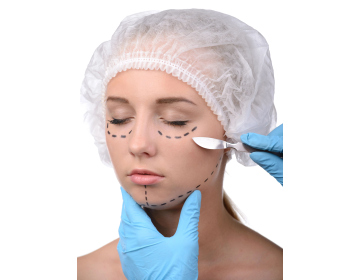
Main Fears of Patients Before Plastic Surgery – A New Survey of Plastic Surgeon Dmytro Slosser’s Audience
Мы продолжаем изучать ожидания и страхи пациентов. На этот раз мы провели опрос в Instagram о личном опыте, мотивации и отношении к эстетическим изменениям. В опросе приняли участие более 600 человек, и его результаты позволяют лучше понять современного пациента пластической хирургии.