Upper Lip Lift Without Fillers: When a Lip Lift Offers a More Natural Result Than Hyaluronic Acid
 All articles
The definition of the upper lip depends not only on its volume but also on its proportions. If the distance between the base of the nose and the upper lip is excessive, the lip may appear thin even when the tissue volume is sufficient. In such cases, hyaluronic acid injections do not always deliver the desired result. An alternative may be an upper lip lift, which shortens the distance between the nose and the lip without adding volume.
What Is an Upper Lip Lift?
An upper lip lift is a plastic surgery procedure in which the surgeon removes a small section of skin beneath the base of the nose and sutures the wound edges together to shorten the distance between the nose and the upper lip. As a result, more of the red part of the upper lip becomes visible, and its shape may appear more defined.
Unlike hyaluronic acid injections, a lip lift does not add volume to the tissues through the use of a filler. Instead, it changes the position of the upper lip and shortens the skin-covered area above it. This distinction determines who may benefit from surgery and who may be better suited to injectable correction.
An upper lip lift may be appropriate if:
- The distance between the base of the nose and the upper lip is increased.
- The red part of the upper lip is narrow, and the lip becomes almost invisible when smiling.
- You want to make the upper lip more defined without adding volume.
- With age, the upper lip has become longer, and the upper front teeth have become less visible when speaking or smiling.
- Previous injections did not produce the desired result because the issue is not a lack of volume but the proportions of the lip.
However, a thin upper lip alone is not an indication for surgery. It is important to assess the length of the skin-covered part of the lip, its shape and symmetry, the position of the teeth, tissue mobility, and the overall proportions of the face.
Why Does the Upper Lip Lose Definition?
The upper lip can appear thin for various reasons. For some people, this is their natural anatomy; for others, the changes become more noticeable with age.
Over time, the skin between the nose and mouth may lose elasticity, and the distance between the base of the nose and the red part of the upper lip may increase. As a result, the lip may appear thinner even if its actual volume has not changed significantly.
If the skin-covered part of the lip is short and the main issue is insufficient volume, a lip lift may not produce the expected result. In this case, injectable correction may be more appropriate.
How Does an Upper Lip Lift Work?
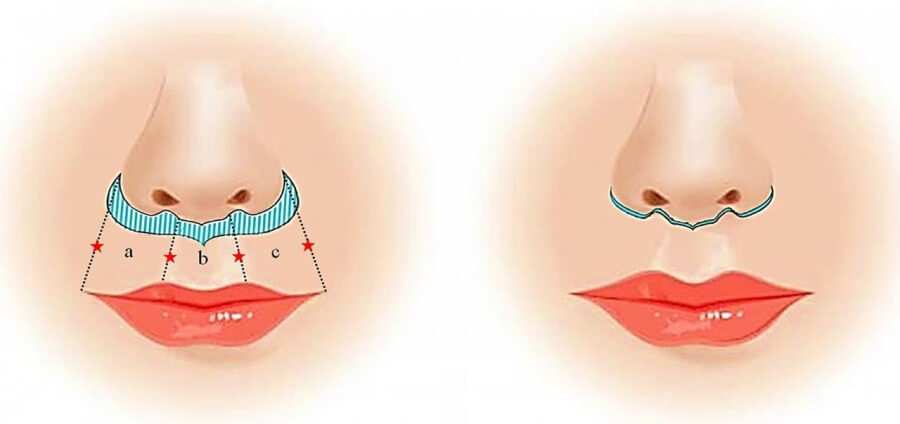
The most common technique is called a subnasal lip lift, or a bullhorn lip lift. The name refers to the shape of the section of skin removed, whose outline resembles a bull’s horns.
The incision is made directly beneath the base of the nose, following the natural contours of the nasal base and nostrils. The surgeon removes a predetermined section of skin and then closes the incision with sutures. This lifts the upper lip and shortens the distance between the nose and the lip.
It is important to determine the appropriate extent of correction. If too much skin is removed, the upper lip may be lifted unnaturally high, the appearance of the area beneath the nose may change, and too much gum tissue may become visible when smiling. If too little skin is removed, the result may be barely noticeable.
The surgeon must also consider how the face will look in motion, whether the smile will remain natural, and how harmoniously the upper lip will look in relation to the lower lip.
Lip Lift or Hyaluronic Acid: Which Is Better?
Both methods can make the upper lip more defined, but they work in different ways. The choice depends on the specific changes you want to achieve.
|
Criterion |
Upper Lip Lift |
Hyaluronic Acid Fillers |
|
Main principle |
Shortens the skin-covered part of the upper lip |
Adds volume through injections |
|
Effect on proportions |
Reduces the distance between the nose and upper lip |
May visually alter proportions but does not shorten the skin |
|
Increase in volume |
Does not add volume through a filler |
Directly increases tissue volume |
|
Duration of results |
Usually long-lasting, although the face continues to change with age |
Temporary; depends on the product and individual factors |
|
Recovery |
Requires wound healing and temporary restrictions on physical activity |
Usually shorter, although swelling and bruising may occur |
Neither method is universally better than the other. A lip lift may be appropriate when the goal is to change the vertical proportions of the upper lip rather than simply make it fuller. If the skin-covered part of the lip is short and the red part is already sufficiently visible, adding a small amount of filler may be a better option.
Fillers do not necessarily produce an unnatural result. With the right product, an appropriate amount, and proper injection technique, they can provide subtle correction. Similarly, surgery does not guarantee a natural-looking result if the indications are assessed incorrectly or the lip is lifted excessively.
What Happens During the Procedure?
First, the plastic surgeon conducts a consultation, reviews the patient’s medical history, assesses their anatomy, and discusses their expectations. During planning, the surgeon determines the area of skin to be removed and the degree to which the upper lip should be lifted.
The procedure is usually performed under local anaesthesia, sometimes with additional sedation. It often takes around an hour, although the duration depends on the technique and extent of correction. In most cases, patients can return home the same day.
The resulting scar is usually positioned in the natural crease beneath the nose. Its appearance depends on the precision of the incision, the quality of the suturing, individual skin characteristics, and the healing process.
Recovery After an Upper Lip Lift
During the first few days after surgery, swelling, bruising, a feeling of tightness, and moderate discomfort may occur. Swelling is often most pronounced on days three to five, after which it gradually subsides.
Sutures are usually removed after approximately five to seven days if a type of suture material requiring removal has been used. Returning to work is often possible after about a week, but this depends on the degree of swelling, the nature of the work, and the plastic surgeon’s recommendations.
During the first few weeks of recovery, pressure on the upper lip, strenuous physical activity, and movements that may place excessive tension on the incision should be avoided. It is also important to follow the instructions for wound care and protect the scar from the sun.
The scar may remain pink and continue to change over several months. Scar maturation often takes three months or longer, so the final result should be assessed at the time recommended by the surgeon.
What Risks Should Be Considered?
An upper lip lift is a surgical procedure, so it should not be considered a simpler or safer alternative to injections in every case. It is important to assess whether the expected result justifies the potential risks.
Complications may include infection, bleeding, wound separation, prolonged swelling, temporary changes in sensation, asymmetry, and a visible or thickened scar. The lip may also be lifted insufficiently or excessively, altering the natural smile or the shape of the base of the nose. In some cases, revision surgery may be required.
Fillers also carry risks. In addition to swelling, bruising, and unevenness, the product can rarely enter a blood vessel or obstruct blood flow. This can impair the blood supply and lead to tissue death. Injections should therefore be performed by a qualified medical professional who understands the anatomy of this area and can recognise and treat complications.
The decision to undergo a procedure should be based on an individual assessment of the risks, rather than the assumption that one method is always better than the other.
How Long Do the Results Last?
The results of an upper lip lift are generally long-lasting because the removed skin does not grow back to its original extent. However, surgery does not stop the natural ageing process. The skin and soft tissues continue to change, so the appearance of the lip may gradually change as well.
Hyaluronic acid fillers are gradually broken down by the body. How long the effect lasts depends on the specific product, the amount used, tissue characteristics, and the individual’s metabolism. Injections usually need to be repeated to maintain the result.
If the goal is to make a slight adjustment to the lip shape or add volume, a temporary method may be more appropriate. If the main concern is excessive length of the skin-covered part of the upper lip, a lip lift may offer a longer-lasting solution.
Frequently Asked Questions About Upper Lip Lifts
Does a lip lift leave a scar?
Yes. A subnasal lip lift leaves a scar beneath the base of the nose. The incision is usually placed along the natural creases to make it less noticeable. Its appearance is influenced by the suturing technique, individual healing characteristics, a person’s tendency to develop prominent scars, and adherence to the surgeon’s postoperative instructions.
Can I have a lip lift if I have had fillers before?
In many cases, yes. Previous injections are not automatically a barrier to surgery. However, the surgeon needs to know which product was used, when the last procedure was performed, and whether any complications occurred. If filler remains in the tissues or there is hardening, swelling, or inflammation, further assessment or treatment may be necessary first.
Will my smile change after surgery?
Yes, some changes are possible because the upper lip will sit higher. In many patients, the upper front teeth become more visible, which is a desired outcome. However, removing too much skin can lead to excessive exposure of the teeth or gums, changes in the shape of the lip when smiling, and an unnatural feeling of tightness. This is why the plastic surgeon should assess the face not only at rest but also while the patient is speaking and smiling.
Can an upper lip lift be combined with lip augmentation?
Yes, in some cases the two methods complement each other. A lip lift changes the vertical proportions, while a filler adds volume. However, this does not mean both procedures need to be performed at the same time. It is important to determine whether additional volume will still be needed after the surgical site has healed and the results have settled.
When can the final result be assessed?
Initial changes are visible immediately, but swelling, tissue tension, and the condition of the scar affect the result during the early stages. Even after the sutures are removed, the lip may look different from how it will look after complete healing. The final assessment is usually made after several months, once the swelling has subsided and the scar has matured.
Is it possible to restore the original shape of the lip?
Part of the skin is removed during a lip lift, so fully restoring the original proportions can be difficult. If the result is excessive or asymmetry occurs, revision surgery may sometimes be possible, but the options depend on the individual case. This is why it is particularly important to discuss the desired degree of lip elevation in advance and avoid aiming for the maximum possible change in a single procedure.

Honored Doctor of Ukraine, Head of the Plastic Surgery Center
Contact me
Plastic surgeon
Ukraine, Kyiv, Shchekavytska St., 9a
(Clinic "Nove Tilo")