Comprehensive Anti-Aging Facial Surgery: What Is It and Who Is It For?
 All articles
As we age, it is not only the skin that changes. Soft tissues descend, the distribution of fat changes, ligaments and muscular structures weaken, and the contours of the jawline and neck become less defined. This is why a single procedure is sometimes not enough to achieve the result a patient expects. Comprehensive facial rejuvenation allows several areas to be addressed at the same time, but only when this is genuinely necessary.
What Is Comprehensive Anti-Aging Facial Surgery?
In plastic surgery, the term “comprehensive anti-aging facial surgery” generally refers to an integrated approach to facial rejuvenation in which several areas affected by ageing are addressed as part of one overall surgical plan.
Most often, this involves combining a facelift with a neck lift and, when indicated, eyelid or brow surgery. In some cases, fat grafting is also included to restore lost volume. A facelift can be combined with a brow lift, blepharoplasty, and other facial rejuvenation procedures.
It is important to understand that, in most cases, there is no need to operate on the entire face. A well-planned comprehensive procedure, on the contrary, involves making clear decisions about which changes genuinely require surgical correction and which are better left untouched.
Broadly speaking, comprehensive rejuvenation may include:
- facelift to correct sagging cheeks, jowls, folds, and loss of definition along the jawline;
- neck lift to address excess skin, localised fat deposits, and vertical platysma bands;
- blepharoplasty to correct excess skin and prominent fat pads of the upper or lower eyelids;
- brow lift for patients whose brow descent contributes to upper-eyelid hooding or a tired facial expression;
- fat grafting in selected cases where significant volume loss accompanies tissue descent.
This is not a standard package of procedures. One person may need only a lower facelift and neck lift, another may benefit from adding blepharoplasty, while someone else may not need surgery on the upper third of the face at all.
Why Is One Procedure Sometimes Not Enough?
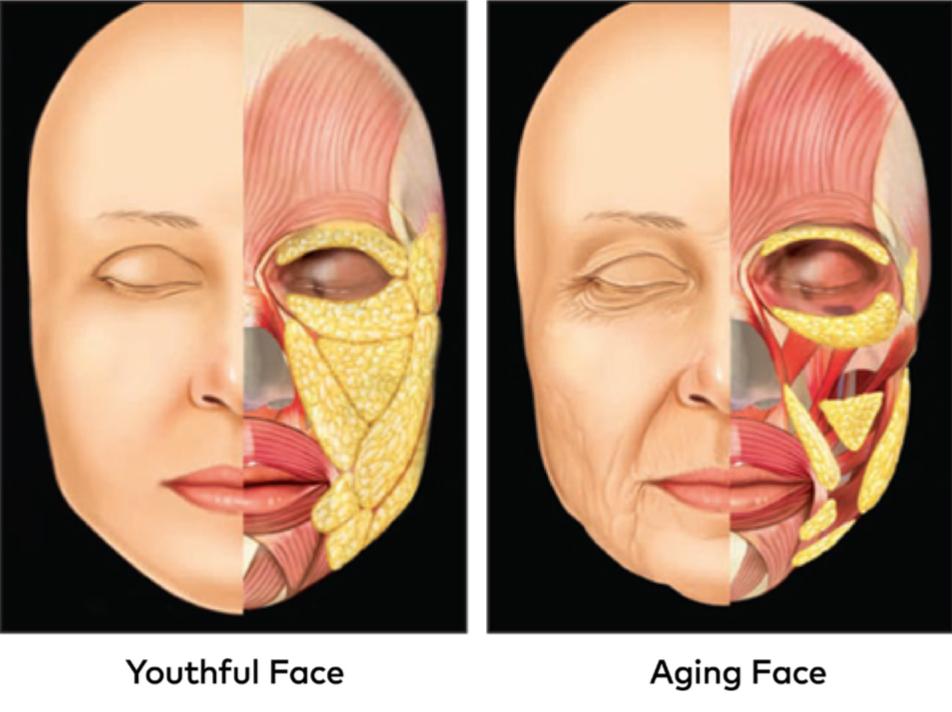
The face ages as a single anatomical system, but different areas change in different ways.
In the midface, nasolabial folds and descent of the cheek tissues may become more noticeable. In the lower third, jowls can develop and the jawline may lose definition. In the neck, excess skin, folds, and vertical platysma bands may appear. Around the eyes, patients may develop excess skin, prominent fat pads, or, conversely, loss of volume.
A facelift is effective for addressing descent of the tissues of the mid and lower face, but it is not designed to correct excess upper-eyelid skin. Blepharoplasty, in turn, does not eliminate jowls or neck laxity. This is why, when age-related changes are pronounced across several areas, a comprehensive approach may produce a more harmonious result than treating one area in isolation.
At the same time, a facelift does not correct every sign of ageing. For example, it is not intended to treat fine lines, photodamage, or uneven skin pigmentation. These concerns require other approaches, including non-surgical treatments.
What Procedures Can Be Included in Comprehensive Facial Rejuvenation?
Facelift
A facelift is designed to correct age-related changes in the soft tissues of the face and neck. During the procedure, the surgeon works not only with the skin but also with deeper tissues, removes excess skin where necessary, and reshapes the facial contours.
Modern facelift surgery should not simply consist of pulling the skin tighter. Depending on the patient's anatomy, a plastic surgeon may work with the superficial musculoaponeurotic system, deeper tissue planes, and fat compartments.
One option is a deep plane facelift, in which deeper facial tissues are repositioned. This technique has its own indications and technical considerations and requires appropriate experience on the part of the plastic surgeon.
Neck Lift
The neck often plays an important role in how youthful or aged the overall facial profile appears. If the lower face has been lifted but the neck remains lax, the result may look incomplete.
During a neck lift, the surgeon may address excess skin, localised fat deposits, and the platysma muscle. In some cases, a neck lift is performed together with a facelift.
However, not everyone with a double chin requires a full neck lift. If the problem is primarily caused by localised fat deposits and the skin still has adequate elasticity, the plastic surgeon may instead perform liposuction of the area.
Blepharoplasty
Eyelid surgery can be an important part of comprehensive rejuvenation when the area around the eyes is the main reason the face appears tired.
Upper blepharoplasty can correct excess skin of the upper eyelids. Lower blepharoplasty may address protruding fat, excess skin, or an uneven transition between the lower eyelid and cheek.
However, blepharoplasty is not always the answer to upper-eyelid hooding. In some cases, brow descent is a significant contributing factor.
Brow Lift
With age, the eyebrows may descend, making the upper eyelids appear heavier. A brow lift is designed to elevate and reposition the tissues in this area and may also improve horizontal forehead lines and frown lines between the eyebrows.
However, I do not consider it appropriate to lift the eyebrows simply “for rejuvenation” when there is no clear indication. An excessively elevated brow position can alter the facial expression and make the result look unnatural.
Restoring Facial Volume
Facial ageing is not only about tissue descent. In some areas, fat volume decreases, while in others it may become more prominent because of tissue displacement or age-related changes.
For this reason, fat grafting is included in the surgical plan for some patients. The aim is not to make the face look fuller. Rather, it is to delicately restore lost volume in areas where doing so improves facial proportions.
How Do You Determine How Much Surgery Is Needed?
During a consultation, I first assess not the patient's age, but the nature of the changes.
It is important to examine the face from the front and in profile, assess skin quality, brow position, the condition of the eyelids, the volume and position of the soft tissues, the jawline, and the neck.
This allows us to answer the key question: what is the minimum amount of surgery required to achieve the desired result?
The word “minimum” is important here. Comprehensive surgery should not turn into a list of every procedure available to a plastic surgeon.
Comprehensive or Localised Correction: Which Is Better?
|
Situation |
Most common concern |
Possible surgical approach |
|
Changes are mainly in the lower third |
Jowls, loss of contour definition |
Lower facelift |
|
The face and neck have both lost definition |
Tissue descent, excess skin, changes in the neck |
Facelift combined with a neck lift |
|
The main concern is around the eyes |
Excess skin or prominent fat pads |
Upper or lower blepharoplasty |
|
Upper-eyelid hooding is related to brow position |
Brow descent |
Brow lift, sometimes combined with blepharoplasty |
|
Both tissue descent and volume loss are present |
Multiple age-related changes |
Facelift + individualised volume restoration |
|
Changes are primarily superficial |
Fine lines, pigmentation, photodamage |
Skincare, laser treatments, or other non-surgical methods |
In other words, a “comprehensive” procedure is not necessarily a better procedure. When the problem is localised, it is usually better to correct that specific area.
How Is Comprehensive Facial Surgery Performed?
The extent and duration of surgery depend on the number of areas being treated and the techniques selected. A facelift itself can take several hours, while additional procedures increase the overall operating time. A facelift typically takes around 3–6 hours, although it may take longer when other procedures are performed at the same time.
Before surgery, the patient undergoes a detailed medical assessment. The surgeon reviews the patient's overall health, medications, expectations, and potential risks.
Particular attention should be paid to smoking. It increases the risk of healing problems, haematoma formation, and skin damage following facelift surgery. Patients should also inform their surgeon about any medications that may affect blood clotting.
What Should the Result Look Like?
The best result of comprehensive facial rejuvenation does not necessarily look like surgery.
I believe it is important to preserve the individuality of the face: its shape, expressions, and distinctive features. The patient should not look like a different person. They should look more rested and refreshed, while still looking appropriate for their age and without obvious signs of excessive tissue tightening.
It is particularly important not to try to “defeat” natural ageing with a single procedure. The face continues to change after surgery because the ageing process does not stop. A facelift can significantly improve the appearance of the face, but it cannot prevent further age-related changes.
How Can I Tell Whether I Actually Need Comprehensive Surgery?
During a consultation with a plastic surgeon, the question should not be “How many procedures do I need?” but rather “Which specific changes do I want to correct?”
If the main concern is limited to one area, a localised procedure is often sufficient. If the face, neck, and eye area have all changed significantly, a comprehensive approach may be more appropriate.
I always prefer to start with the smallest surgical plan that can achieve the desired result. Plastic surgery should not become a competition over the number of procedures performed. Its purpose is to address a specific concern as precisely as possible while preserving natural-looking results and patient safety.
Frequently Asked Questions About Comprehensive Facial Rejuvenation
Does comprehensive anti-aging surgery mean that the entire face needs to be operated on?
No. This is an important distinction.
Comprehensive rejuvenation means assessing the face as a whole and correcting the areas where genuine age-related changes are present. One patient may need a facelift and neck lift, another may need only eyelid surgery, while someone else may benefit from adding blepharoplasty to a facelift.
Can all the procedures be performed at the same time?
In some patients, several procedures can be combined into a single operation. However, whether this is appropriate depends on the extent of surgery, the duration of anaesthesia, the patient's overall health, and individual risks.
Performing the maximum possible number of procedures at once is not always the safest approach.
Which is better: a deep plane facelift or SMAS facelift?
There is no universal answer.
SMAS and deep plane are different surgical approaches to the deeper tissues of the face. The choice depends on the patient's anatomy, the nature of the age-related changes, the amount of excess skin, the condition of the neck, and the surgeon's experience.
Can a facelift be performed without a neck lift?
Yes. The decision depends on the condition of the neck.
If the neck has retained good quality and definition, a separate neck lift may not be necessary. If there is significant laxity, excess skin, or platysma changes, leaving the neck untreated may not be appropriate.
Does a facelift replace blepharoplasty?
No. Facelift and blepharoplasty address different anatomical areas. A facelift is not intended to remove excess upper-eyelid skin or correct prominent fat pads of the lower eyelids. When indicated, the procedures can be performed together.
Can a brow lift and blepharoplasty be performed at the same time?
Yes, in appropriate cases these procedures can be combined. However, the first step is to determine what is actually causing the upper-eyelid hooding: excess skin, brow position, or a combination of both.
How many years does a facelift take off?
I do not recommend assessing the result in terms of a specific number of years.
The purpose of surgery is not to make someone look, for example, 15 years younger. It is much more appropriate to think in terms of restoring facial contours and proportions that have changed with age.
Does the result last forever?
No. Surgery does not stop the ageing process. It corrects the changes that are already present, after which the natural ageing process continues. At the same time, the results of a facelift can last for many years and gradually change as the patient ages.
Can injectable and energy-based treatments be performed after a facelift?
In many cases, yes. However, the timing and suitability of specific treatments should be determined together with the surgeon once the main stage of healing has been completed.
Surgical and non-surgical treatments do not necessarily compete with one another. They address different concerns. A facelift changes the position of the tissues and the contours of the face, while laser and other treatments can primarily improve skin quality.
Honored Doctor of Ukraine, Head of the Plastic Surgery Center
Contact me
Plastic surgeon
Ukraine, Kyiv, Shchekavytska St., 9a
(Clinic "Nove Tilo")