Facial Reconstruction After Severe Trauma: From 3D Modeling to Functional Restoration
 All articles
Facial injuries are among the most complex cases in reconstructive surgery. They affect not only a person’s appearance but also essential functions such as breathing, chewing, speech, and the normal functioning of the airways.
In my medical practice, I frequently encounter patients who require comprehensive restoration of facial anatomy after severe trauma. In such cases, we are not talking about a single procedure, but rather a series of reconstructive interventions aimed at restoring both structure and function.
The most common causes of severe facial trauma include road traffic accidents, falls from height, sports injuries, and combat-related wounds. These injuries often affect multiple anatomical structures: the bones of the midface, the orbits, the upper and lower jaw, soft tissues, as well as the nose — a central and functionally critical part of the face.
Such trauma is often accompanied by fractures of the midface — the so-called Le Fort fractures. This classification was described by the French surgeon René Le Fort in the early 20th century and is still used in maxillofacial surgery to assess the severity of injuries.
According to this classification, fractures are divided into three main types depending on the level of disruption of the midfacial bony structures.
Le Fort I — a horizontal fracture of the maxilla, in which the lower portion of the upper jaw separates together with the dental arch.
Le Fort II — the so-called pyramidal fracture, involving the nasal bones, maxilla, and the inferior orbital rims.
Le Fort III — the most severe form, in which there is a complete separation of the midface from the cranial base.
In such cases, multiple key anatomical structures are affected simultaneously, and facial reconstruction requires a staged approach to restore bone fragments, soft tissues, and functional anatomy. Particular attention is given to nasal reconstruction, as the nose is frequently severely deformed and plays a crucial role in respiration.
The Role of Digital Technologies in Treating Severe Facial Trauma
Modern reconstructive surgery has been transformed by advances in digital technologies. Today, one of the key stages in preparing for complex procedures is computed tomography combined with three-dimensional modeling. Based on CT data, an accurate digital model of the patient’s face is created, allowing for detailed assessment of anatomy, extent of injury, and precise preoperative planning.
In fact, these technologies enable the surgeon to simulate the procedure in a virtual environment before entering the operating room. This makes it possible to produce patient-specific anatomical models, surgical guides, and even customized implants, significantly improving surgical accuracy and outcomes.
Why Nasal Reconstruction Is One of the Most Complex Procedures
Reconstruction of the nose after severe trauma remains one of the most technically demanding procedures in plastic surgery. This is due to the complex, multilayered anatomy of the nose, where bone, cartilage, and soft tissues must function together. During reconstruction, it is necessary to restore the bony framework, cartilaginous support, and skin envelope in order to achieve not only an aesthetic result but also proper nasal breathing.
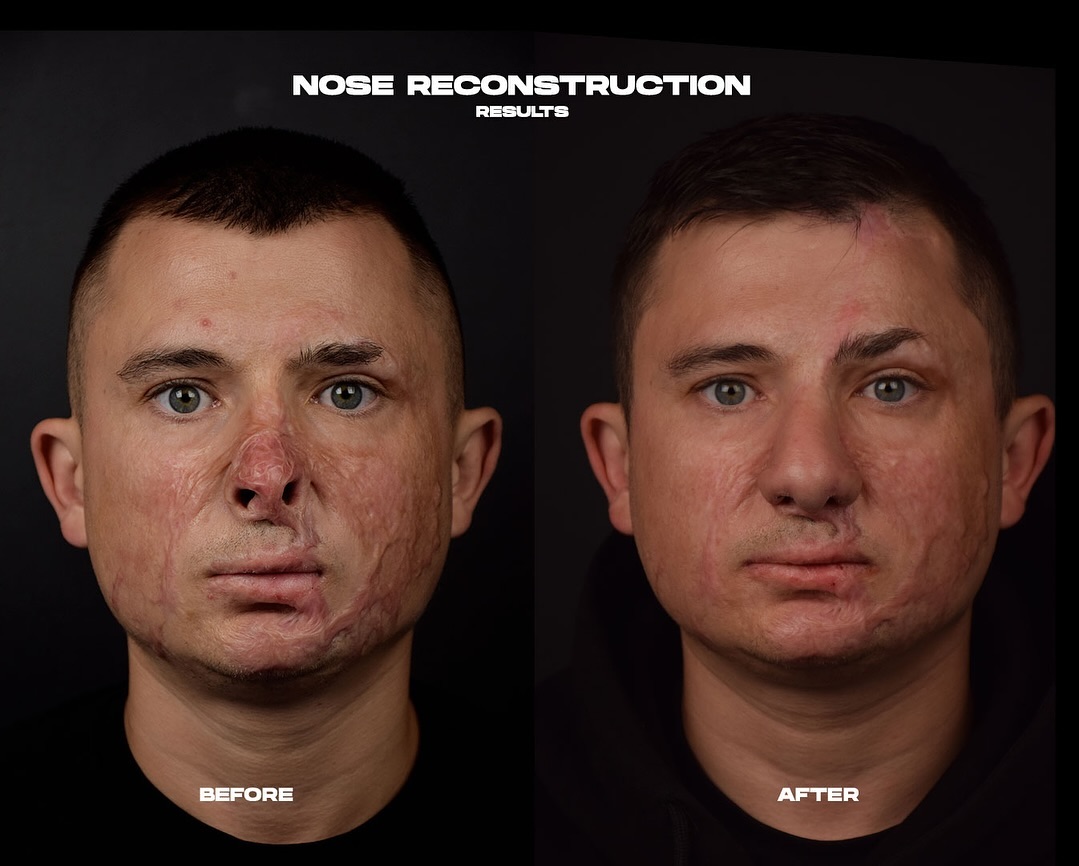
Autologous tissues are most commonly used for this purpose. Cartilage grafts can be harvested from the nasal septum, the ear, or the rib. This approach is considered the gold standard in reconstructive rhinoplasty, as it ensures excellent biocompatibility and long-term stability.
In cases of extensive soft tissue loss, advanced reconstructive techniques are required. One of the most well-known is the paramedian forehead flap — a technique in which tissue from the forehead is used to reconstruct the nasal framework. This method has a long history and remains one of the most reliable options in complex nasal reconstruction.
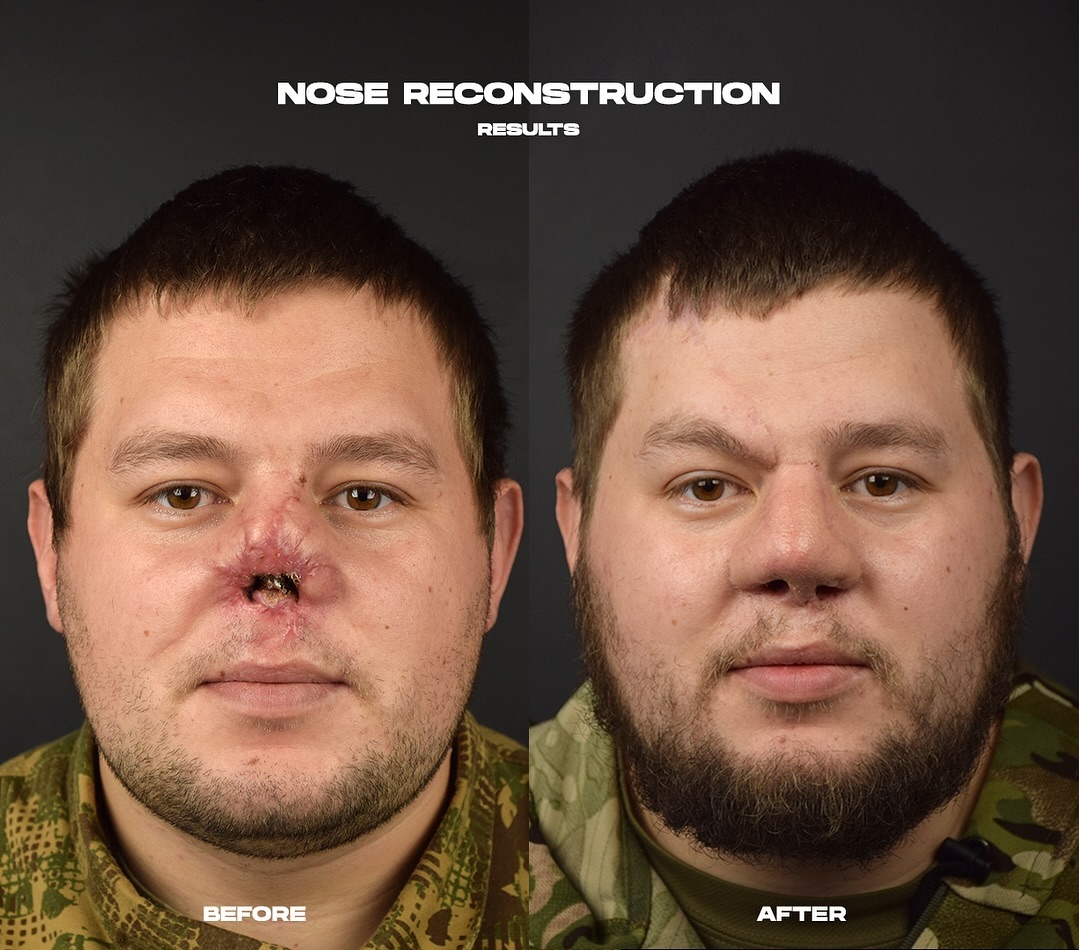
At the same time, modern technologies continue to expand the possibilities of reconstruction. Today, 3D printing of anatomical models, digital surgical planning, and patient-specific implants are widely used. These tools help surgeons restore facial proportions and nasal function with a high degree of precision.
Other Surgical Interventions After Facial Trauma
Facial reconstruction often involves additional procedures, including orbital fracture repair, reconstruction of the upper or lower jaw, restoration of midfacial contours, and soft tissue correction. It is this comprehensive approach that allows for achieving a harmonious and balanced result.
However, in reconstructive surgery it is essential to remember that aesthetics can never be the sole objective. The primary goal is always the restoration of function — normal breathing, proper alignment of skeletal structures, the ability to chew, and natural facial symmetry. The true success of reconstruction lies in the balance between functional and aesthetic outcomes.
For patients who have experienced severe facial trauma or combat-related injuries, such surgery means far more than a change in appearance. It is an opportunity to return to normal life — to breathe freely again, to speak, to smile, and to confidently recognize themselves in the mirror. That is why modern reconstructive surgery combines advanced technology, precise planning, and surgical expertise to help patients regain a full and active life even after the most severe injuries.

Honored Doctor of Ukraine, Head of the Plastic Surgery Center
Contact me
Plastic surgeon
Ukraine, Kyiv, Shchekavytska St., 9a
(Clinic "Nove Tilo")